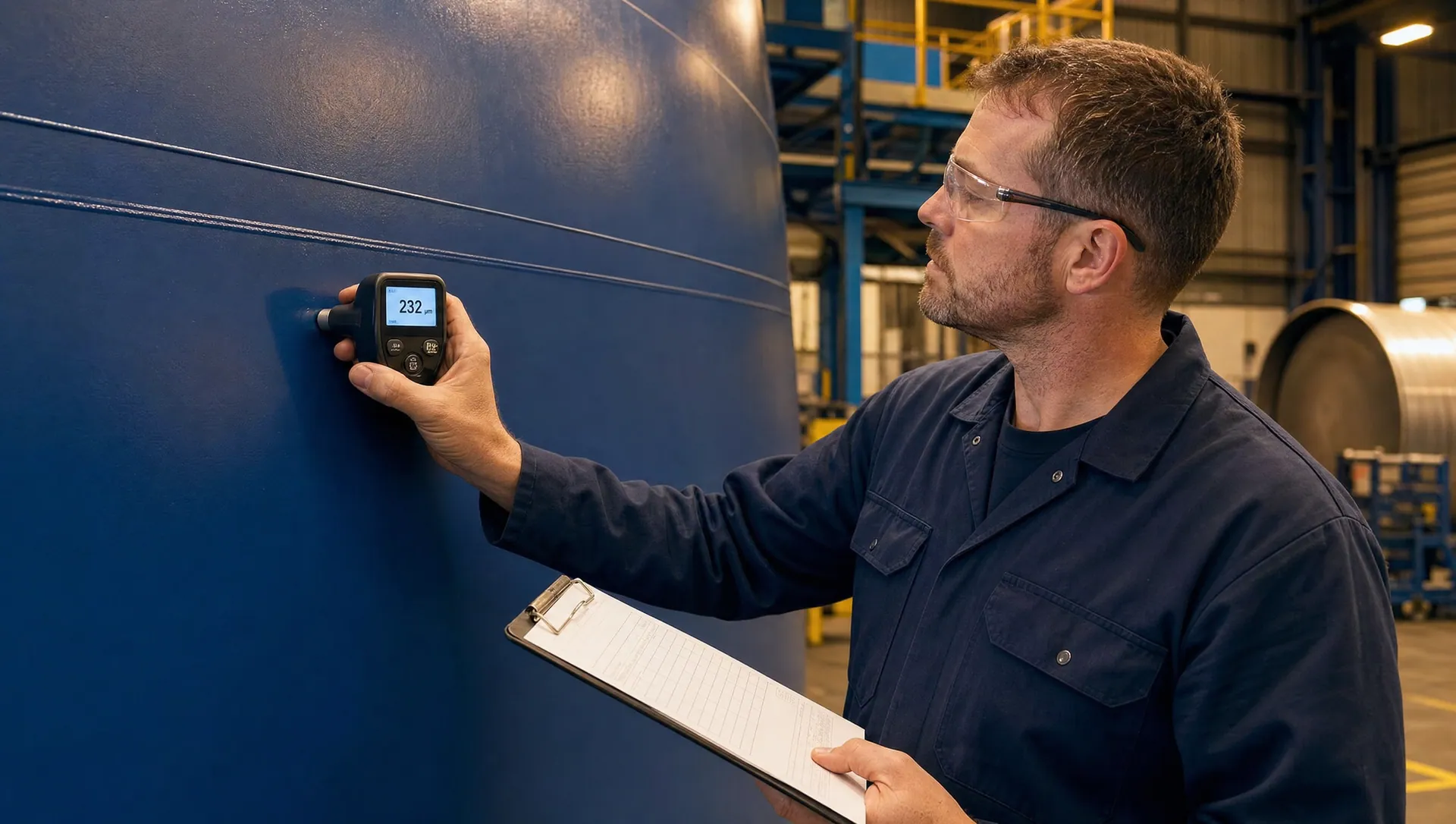
Asset owners specifying long-life linings increasingly ask who is allowed to apply them. Being on our list answers that question before it is asked.
Many long-life lining specifications name an approved applicator list. Certification puts you on ours, so you can bid work that is otherwise closed to you.
Substrate surprises, humidity swings, an awkward geometry: you get a coating engineer on the phone, not a ticket queue.
Work reaches us from regions we do not cover with our own crews. Certified applicators are who we pass it to.
Product and workmanship assurance carries weight with an owner only when the applicator is certified and the QA record is complete. We help you produce both.
The commercial arrangement differs by partner type. The technical bar does not.
You already blast and spray. Glass flake sits at the top of the market you are quoting in, and it is the part of a tender you are most likely to be losing on capability rather than price. Certification lets you quote the full scope instead of subcontracting the lining out.
Drydock time is the expensive commodity, and waiting on an outside lining crew is how it gets spent. Certifying your own team means the coating stage moves when your programme says it moves, not when a subcontractor is free.
Selling a specialist lining without being able to apply it, or judge whether it was applied correctly, is a short-lived business. Distributor partners certify so they can support their own customers technically. We discuss territory case by case.
Refineries, water treatment plants, power stations and process facilities that maintain their own tanks, clarifiers and pipework. Certifying in-house crews turns an emergency callout into a planned shutdown task.
Every applicant goes through all four. We do not shorten the path for a large name, and we do not lengthen it for a small one.
Before anyone touches a spray gun, your team works through the chemistry and the standards: why glass flake behaves differently from a filled epoxy, what the flake orientation is actually doing to the permeation path, how to read a lining specification, and what the QA record has to prove when the job is handed over.

The practical stage runs one of two ways, and both end at the same standard. Come to our Miami facility and train on our equipment and test panels, or we send an engineer to you and train your crew on your kit, in your conditions, on the substrates you actually work with.

Test panels are not a tank. Your first live Polyflake project runs with one of our engineers present, reviewing preparation, application and the QA record as the work happens. It is the stage applicants tell us they get the most from, because problems get solved on the staging rather than in a report afterwards.

Pass all three stages and your organisation is issued Polyflake applicator certification, added to our approved applicator list, and given the technical and specification support that goes with it. Certification is held by the company and tied to the named personnel we trained, so it stays honest.

The more you tell us here, the faster we can tell you whether the programme fits. A Polyflake engineer reviews every application personally and responds within two business days. Prefer to talk it through first? Call +1 (877) 704-2012.
An engineer reviews your application and comes back within two business days. If it looks like a fit, the next step is a short call to go through your equipment, your markets and the commercial arrangement before anything is scheduled.
It depends on your availability and on when a suitable first project comes up, which is usually the part that sets the pace. The theory module and the hands-on stage can move quickly. The supervised project has to wait for real work. Tell us your situation on the form and we will give you a realistic timeline rather than a marketing one.
Training and certification costs depend on the route you choose, how many of your people we train, and whether we travel to you. We quote it once we understand the scope, and we tell you the number before anything is booked. There are no ongoing licence fees for holding certification.
We discuss territory case by case with distributor partners, taking into account the market, your reach and the commitment you are making. We would rather have one committed partner in a region than three half-interested ones, but we do not make blanket exclusivity promises on a web page.
No. The programme is open worldwide, and on-site training exists precisely so that distance is not a barrier. What matters more than location is whether you have the equipment, the crew and the market to make it worthwhile for both of us.
That is the normal starting point, and it is exactly who the programme is designed for. What we cannot shortcut is general industrial blasting and coating experience. If your team already prepares and coats steel to a professional standard, the glass-flake specifics are learnable.
Certification is held by your company and tied to the people we trained, so tell us when key personnel change. We will arrange training for their replacement. Letting the trained staff quietly disappear while the certificate stays on the wall is the one thing that would put your listing at risk.
No. Product supply on applicator terms follows certification. This is deliberate: our reputation and the 25-year performance we quote both depend on the work being done correctly, and the fastest way to lose both would be to let uncertified crews apply the system.
Send us the application. If the programme is not right for you, we will say so plainly and quickly rather than keep you in a pipeline.